
Perfume Bottle Decoration: The Documents and Compliance Checklist
A decorated perfume bottle carries two products at once: the fragrance inside and the packaging around it, and both have documents attached. The label artwork, the claims printed on it, the market registration and the traceability of the inks and coatings all leave a paper trail, and the brand should hold that trail before the first carton ships. Most compliance problems in fragrance launches are paperwork problems — and paperwork problems are the cheapest ones to fix early.
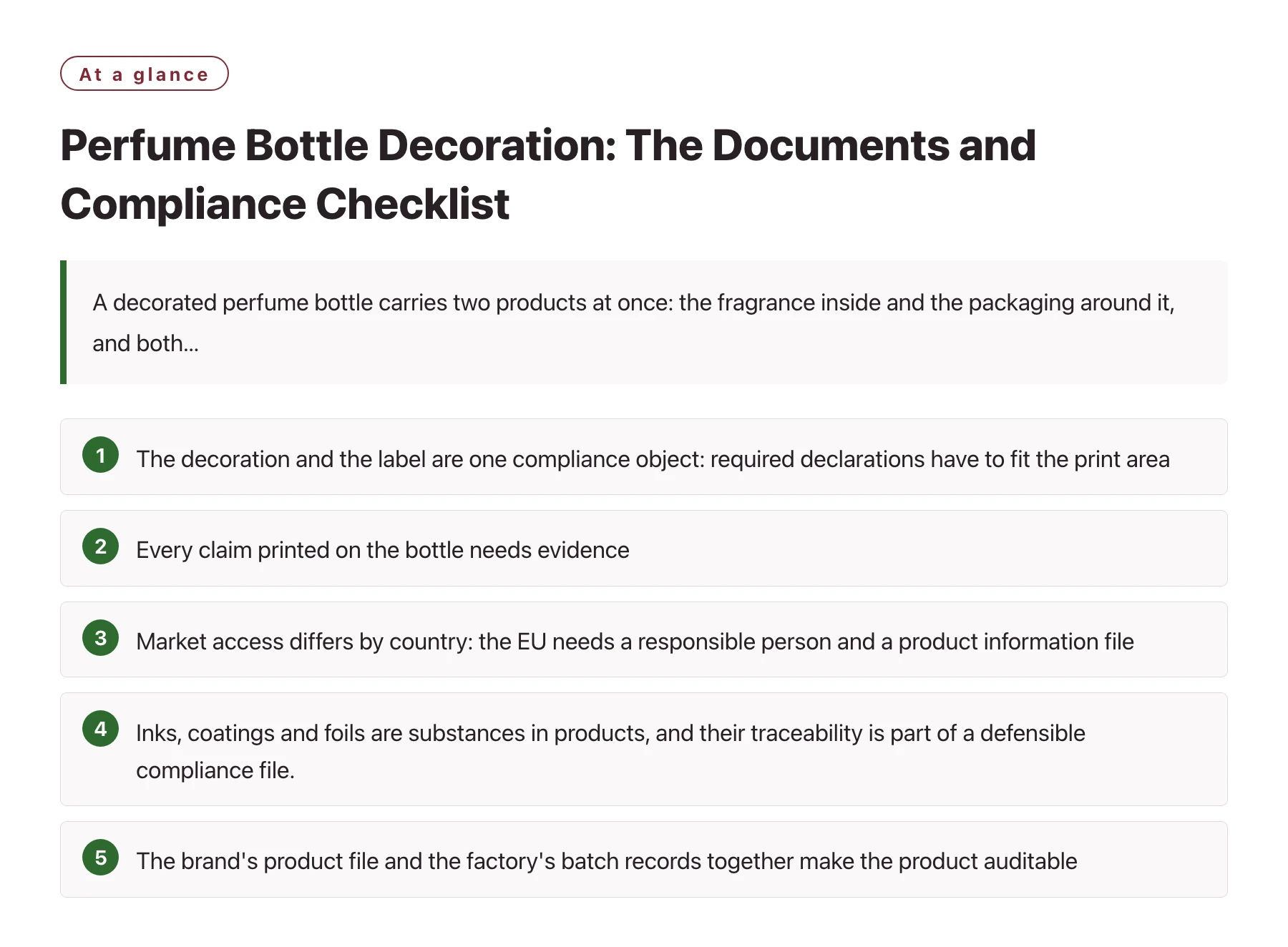
Key takeawaysThe decoration and the label are one compliance object: required declarations have to fit the print area, which is planned with the glass. · Every claim printed on the bottle needs evidence, because claims rules apply to the label as much as to any advertisement. · Market access differs by country: the EU needs a responsible person and a product information file, Canada a notification, and other markets their own sets. · Inks, coatings and foils are substances in products, and their traceability is part of a defensible compliance file. · The brand's product file and the factory's batch records together make the product auditable; neither half replaces the other.
New fragrance brands usually discover compliance in the wrong order: they design a beautiful bottle, print it, and only then learn that the legal text does not fit, the claim cannot be substantiated, or the market needs a document nobody has. The order that works is the reverse.
This checklist covers the documents attached to a decorated bottle — the label map, the claims file, the market registration and the ink traceability — and who should hold each one.
Start with the label map, not the artwork
The decoration brief should begin with a label map: which claims, declarations and legal text the bottle must carry, and where each element sits on the surface. In the EU, cosmetics rules set out what a product information file must hold and which obligations fall on the brand's responsible person, and the label text is a visible consequence of that file [1].
When the label map comes first, the print area is designed around the required text. When the artwork comes first, the required text grows into the decoration and the design is remade — usually at tooling cost.
A supplier that documents its systems makes this early audit faster, because its background and certifications its background and certifications are on the record and can be checked in minutes rather than extracted through rounds of email.
Claims, allergens and the ink on the glass
Every claim needs a file behind it
Anything printed on the bottle is a claim with the same evidentiary burden as an advertisement: 'long lasting', 'natural' or a sustainability statement has to be provable. The evidence — test results, composition data, certification — is part of the compliance pack, and it must exist before the artwork is approved, because the label carries the promise.
Allergen declarations shape the print area
In the EU, fragrance allergens above set thresholds must be declared on the label, and the thresholds follow the scientific assessments of fragrance materials [2]. The declaration list comes from the formula, so the artwork brief has to know the formula's allergen picture before the layout is fixed.
The decoration materials are substances too
The ink, coating and foil on the bottle are substances placed on the market inside a product, and international chemicals-management programmes push for transparency about substances in products [3]. Ask the factory for the composition and safety information of the decoration materials and keep it in the file — it is the paperwork behind a defensible product.
The document pack, item by item
| Document | What it proves | When you need it |
|---|---|---|
| Label map and artwork approval | The required text in the right place | Before any tooling is made |
| Claim substantiation file | Each claim has evidence behind it | Before artwork approval |
| Product information file (EU) | Safety assessment and product data | Before first market placement |
| Market notification or registration | Access to the destination market | Before the first shipment |
| Certificate of analysis per batch | The batch matches the approved reference | With every delivery |
| Decoration material data | Traceability of inks, coatings, foils | With the product file |
| Test reports | Stability, microbiology, safety | Before release |
Read the table from the bottom: batch records and test reports come from the factory, market documents are the brand's job, and the label map sits between the two. The brand that holds all seven can answer any question an importer or an auditor asks.
Who holds which document
The split is cleaner than most brands expect. The factory holds batch-level evidence: certificates of analysis, test reports for the batches it produced and material data for the decoration. The brand holds product-level evidence: the formula file, the claims file, the label map and the market registration. Neither half replaces the other.
A market such as Canada adds its own layer: cosmetics need to be notified and to respect the restricted-ingredient hotlist before they are placed on the market [4]. When a brand plans several markets, the file is built once and extended per market, which is why the destination list belongs in the brief rather than being discovered along the way.
The paperwork load is one reason brands often prefer a partner with a standing compliance process: a house like Xuelei that has carried many products through the same documentation runs the batch-level half as routine, which leaves the brand's own half — the label map and the market file — as the only part built from scratch.
Sources
- European Commission: Cosmetics in the EU —— The European Commission's overview of EU cosmetics rules, including the responsible person, product information file and safety report requirements.
- EU Scientific Committee on Consumer Safety (SCCS) —— The EU scientific committee that issues opinions on the safety of cosmetic ingredients, including fragrance allergens and their labelling thresholds.
- UNEP: Chemicals and Pollution Action —— The UN Environment Programme's pages on chemicals management, including the sound management of chemicals in products.
- Health Canada: Cosmetic Safety —— Health Canada's cosmetics pages, covering cosmetic notification, the ingredient hotlist and safety requirements for cosmetics sold in Canada.
Frequently asked questions
Which compliance documents do I need before the first shipment?
At minimum: the label map and approved artwork, the claim substantiation file, the market registration or notification for each destination country, batch certificates of analysis and the product safety documentation the market requires. The exact list depends on the market, which is why destinations should be named in the brief.
Who is responsible for compliance documents, the brand or the factory?
Both, in different halves. The factory provides batch-level evidence: analysis, test reports and material data. The brand holds product-level evidence: formula file, claims, label map and market registration. Neither half can fully replace the other.
Does a label claim need evidence even if it is obviously true?
Yes. Every claim printed on the bottle should be traceable to a file — test results, composition data or a certification. An auditor asks for the record, not for common sense, so the evidence has to exist before the artwork is approved.
My bottle has no label, only printed glass. Do the same rules apply?
Yes. Printing replaces labelling in the decoration, and the required declarations still have to be carried somewhere on the pack — printed, labelled or engraved. The print area has to plan for that text either way.
How long before launch should compliance work start?
As early as the schedule allows: the label map and claim decisions belong with the artwork, the market registration with the formula, and the test plan with the first samples. Compliance left for the last month is the most common cause of a delayed launch.
Specify WallProtect for your next project
Request a free sample kit, Revit families, and ISO/ASTM documentation — delivered within 5 working days for stocked colors.
Request a Free Sample Kit