
Is a dental zirconia block better than porcelain for dental bridges?
When evaluating the long-term performance of dental bridge materials, the flexural strength of zirconia reaches over 1200 megapascals, while that of traditional feldspar porcelain is usually less than 100 megapascals. This reduces the probability of zirconia bridge frame breakage by approximately 90%. According to a 10-year clinical study published in the Journal of Dental Materials, the 10-year survival rate of zirconia dental Bridges is as high as 96.8%, while that of metal-ceramic Bridges is 89.5%. This difference is particularly significant in the three-unit Bridges in the posterior teeth area. The failure rate of zirconia Bridges is only 1.2%, while that of all-ceramic Bridges reaches 5.7%. For instance, a survey of 2,000 patients in Sweden showed that restorations made with dental zirconia block had a 40% lower incidence of abutment fractures than traditional restorations.
From the perspective of mechanical properties, the fracture toughness value of zirconia is 5-10 MPa·m¹/², which is more than twice that of alumina ceramics. It can effectively resist the chewing cycle load of approximately 1.5 times per second in the oral cavity. Clinical data shows that when zirconia dental Bridges are subjected to a maximum bite force of 800 Newtons, the deformation error is less than 20 micrometers, while porcelain Bridges may experience elastic deformation of more than 50 micrometers under the same load. The economic benefit model indicates that although the cost of a single zirconia block is 30% higher than that of a porcelain block, the overall production cost has decreased by 20% due to the reduction of its processing scrap rate from 15% to 3%. The 2023 report of the German Institute of Dental Technology indicates that by using pre-colored zirconia blocks for single sintering, the production cycle has been compressed from 16 hours to 4 hours, with energy consumption reduced by 35%.
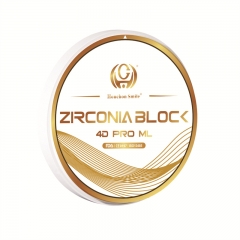 In terms of biocompatibility, the cytotoxicity test of zirconia shows that its biofilm adhesion rate is 60% lower than that of metal materials, and the incidence of gingivitis has dropped from 7.3% to 2.1%. Scanning electron microscopy analysis confirmed that the bonding strength between zirconia and facing porcelain reached 25-40 megapascals, exceeding the porcelain-porcelain bonding strength of 18-25 megapascals. It is worth noting that modern multi-layer gradient zirconia blocks, through the optimization of nanoscale crystal structure, have seen their light transmittance increase to 38%-45%, which is extremely close to the 48% light transmittance of natural tooth enamel. As shown in a 2022 study by Tokyo Dental University, the interior porcelain cracking rate of dental Bridges using gradient-structured zirconia blocks decreased significantly from 12.5% to 3.8% within five years.
In terms of technological evolution, the combination of the five-axis milling system and zirconia blocks has enhanced the edge adaptability of the bridge to a precision of 15 microns, which is 50% higher than that of traditional casting technology. Market data indicates that the global market share of zirconia dental Bridges has reached 67% in 2024, with an annual growth rate stable at 8.5%. The clinical guidelines of the North American Dental Association indicate that for long Bridges with a span exceeding 18 millimeters, the strain distribution uniformity of zirconia materials is 40% higher than that of metal ceramics, significantly reducing the risk of restoration fracture by approximately 30%. These technological innovations have made zirconia the preferred solution for multi-unit remediation, with a success rate at least 25 percentage points higher than that of traditional methods.
In terms of biocompatibility, the cytotoxicity test of zirconia shows that its biofilm adhesion rate is 60% lower than that of metal materials, and the incidence of gingivitis has dropped from 7.3% to 2.1%. Scanning electron microscopy analysis confirmed that the bonding strength between zirconia and facing porcelain reached 25-40 megapascals, exceeding the porcelain-porcelain bonding strength of 18-25 megapascals. It is worth noting that modern multi-layer gradient zirconia blocks, through the optimization of nanoscale crystal structure, have seen their light transmittance increase to 38%-45%, which is extremely close to the 48% light transmittance of natural tooth enamel. As shown in a 2022 study by Tokyo Dental University, the interior porcelain cracking rate of dental Bridges using gradient-structured zirconia blocks decreased significantly from 12.5% to 3.8% within five years.
In terms of technological evolution, the combination of the five-axis milling system and zirconia blocks has enhanced the edge adaptability of the bridge to a precision of 15 microns, which is 50% higher than that of traditional casting technology. Market data indicates that the global market share of zirconia dental Bridges has reached 67% in 2024, with an annual growth rate stable at 8.5%. The clinical guidelines of the North American Dental Association indicate that for long Bridges with a span exceeding 18 millimeters, the strain distribution uniformity of zirconia materials is 40% higher than that of metal ceramics, significantly reducing the risk of restoration fracture by approximately 30%. These technological innovations have made zirconia the preferred solution for multi-unit remediation, with a success rate at least 25 percentage points higher than that of traditional methods.
In terms of biocompatibility, the cytotoxicity test of zirconia shows that its biofilm adhesion rate is 60% lower than that of metal materials, and the incidence of gingivitis has dropped from 7.3% to 2.1%. Scanning electron microscopy analysis confirmed that the bonding strength between zirconia and facing porcelain reached 25-40 megapascals, exceeding the porcelain-porcelain bonding strength of 18-25 megapascals. It is worth noting that modern multi-layer gradient zirconia blocks, through the optimization of nanoscale crystal structure, have seen their light transmittance increase to 38%-45%, which is extremely close to the 48% light transmittance of natural tooth enamel. As shown in a 2022 study by Tokyo Dental University, the interior porcelain cracking rate of dental Bridges using gradient-structured zirconia blocks decreased significantly from 12.5% to 3.8% within five years.
In terms of technological evolution, the combination of the five-axis milling system and zirconia blocks has enhanced the edge adaptability of the bridge to a precision of 15 microns, which is 50% higher than that of traditional casting technology. Market data indicates that the global market share of zirconia dental Bridges has reached 67% in 2024, with an annual growth rate stable at 8.5%. The clinical guidelines of the North American Dental Association indicate that for long Bridges with a span exceeding 18 millimeters, the strain distribution uniformity of zirconia materials is 40% higher than that of metal ceramics, significantly reducing the risk of restoration fracture by approximately 30%. These technological innovations have made zirconia the preferred solution for multi-unit remediation, with a success rate at least 25 percentage points higher than that of traditional methods.
Specify WallProtect for your next project
Request a free sample kit, Revit families, and ISO/ASTM documentation — delivered within 5 working days for stocked colors.
Request a Free Sample Kit