
Industrial Transformation: Leveraging Biomanufacturing for Sustainable Economic Growth
The formal designation of biomanufacturing as a cornerstone of the 15th Five-Year Plan (2026-30) marks a shift toward "new quality productive forces" that prioritize resource efficiency and low-carbon outputs. By integrating synthetic biology with industrial engineering, this sector is effectively converting waste streams into high-value commodities, such as turning used cooking oil into sustainable aviation fuel.
Currently, the scale of China's biomanufacturing industry has reached 1.1 trillion yuan ($159.5 billion), with projections suggesting a growth to 1.8 trillion yuan by 2030. This expansion would account for nearly 25% of the global market share, positioning the nation as a central hub for the global bioeconomy.
The efficiency gains inherent in this technology are best illustrated by the production of artemisinin. Traditional cultivation formerly required 50,000 mu (3,333 hectares) of land and 18 months of growth; however, modern biomanufacturing can achieve the same output in a 100-cubic-meter industrial fermenter within just a few weeks. This represents an exponential reduction in land use and a significant acceleration of the production cycle.
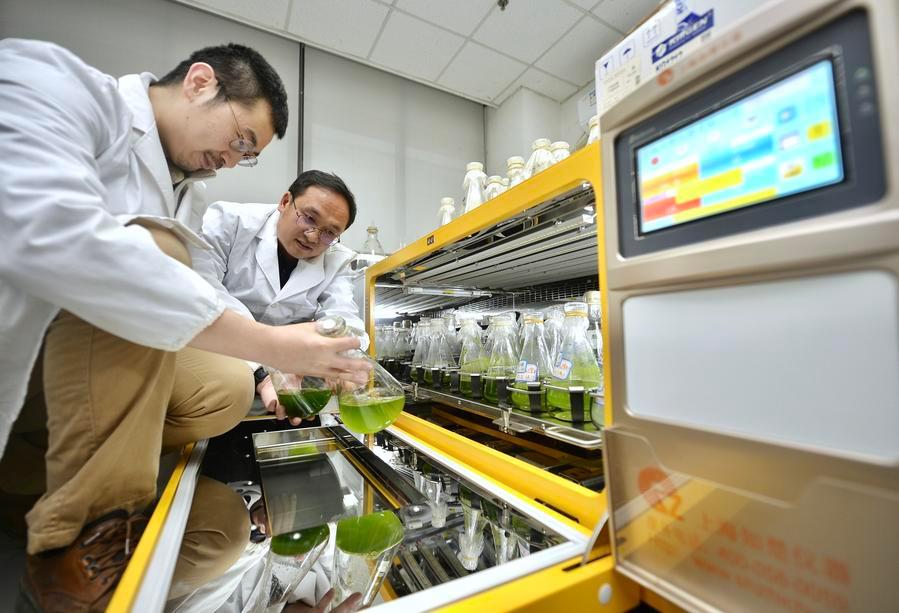
According to reports from People's Daily, China’s contribution to global biomanufacturing academic publications and patent applications now exceeds 20%. This innovation capacity is further bolstered by the integration of artificial intelligence, with 16 typical AI application cases released by the Ministry of Industry and Information Technology in August 2025 to optimize microbial strain development and fermentation parameters.
The strategic significance of this sector lies in its ability to provide green substitutions for bulk chemicals, thereby reducing the environmental footprint of traditional manufacturing. By creating new sectors in biomaterials, bioenergy, and biochemicals, the industry is providing a diversified range of investment opportunities for both domestic and international enterprises looking to align with global ESG (Environmental, Social, and Governance) standards.
From a global perspective, the competitive edge is moving toward systemic integration. While other regions focus on niche high-end genomics, the current Chinese strategy emphasizes large-scale market applications and whole-industrial-chain collaboration. This approach is designed to meet national needs for food security and industrial upgrading while maintaining long-term competitive advantages in the global value chain.
Furthermore, the transition from laboratory research to industrialization is reaching a critical peak. The ability to produce sophisticated biological products domestically not only supports pharmaceutical self-sufficiency but also builds the infrastructure necessary to serve international markets. This dual-purpose capability is essential for sustaining economic momentum as global demand for sustainable products increases.
To maintain this trajectory, the industry must continue to focus on reducing production costs and improving the "energy-to-output" ratio of industrial fermentation. If the projected growth to 1.8 trillion yuan is realized, biomanufacturing will likely become one of the most significant drivers of the nation’s "manufacturing powerhouse" objectives by the end of the decade.
In summary, biomanufacturing represents a profound shift in industrial logic, moving from resource extraction to biological synthesis. The synergy between 20% global patent contributions and massive domestic market application creates a resilient framework for greener growth that balances economic output with ecological preservation.
News source:https://peoplesdaily.pdnews.cn/business/er/30051806292
Specify WallProtect for your next project
Request a free sample kit, Revit families, and ISO/ASTM documentation — delivered within 5 working days for stocked colors.
Request a Free Sample Kit