
Low-Emission Glue Systems in Birch Boards: E1, E0 and CARB P2
Low-emission glue is the specification line that decides where a board can live. Birch boards bonded with E1 or E0 glue and documented to CARB P2 serve interiors where the air itself is part of the product: homes, schools, hotels and shops where panels are sanded, painted and lived around.
Key takeaways
- E1 and E0 are the low-emission glue classes named for interior boards.
- CARB P2 documentation and CE documentation are the compliance options published for the range.
- The face is a light cream to pale brown birch veneer, uniform and suited to staining, laminating or painting.
- Sizes run from 1220 × 2440 mm up to 1250 × 3000 mm, with 1250 × 2500 mm in between, and the thickness window reaching 2.7 mm to 30 mm.
What low-emission means for interior boards
Emission class is about the air a room breathes over the life of the board. Plywood is veneer and glue in roughly equal measure by volume, and the glue line is where formaldehyde and other emissions originate. A low-emission system reduces that source, and the class — E1 or E0 — is the published measure of how far the reduction goes.
For a buyer the class is a placement decision. Boards documented to a low-emission class can be specified for the rooms where people spend the longest: bedrooms, classrooms, hotel corridors and retail interiors. Boards without the documentation are confined to spaces where the emission question never arises. The glue line is invisible, but it decides where the panel can be sold.
E1 and E0 glue classes
E1 and E0 are the two low-emission classes named in the client's own compliance options, alongside CARB P2 and CE documentation. The classes form a ladder: E1 is the established low-emission grade for interior work, and E0 is the tighter grade for projects where the specification asks for less again. The difference is a number on a test report, and the test report is what the specification should reference.
The glue system also affects how the board behaves in service. Low-emission systems are engineered to bond hardwood veneer without excess resin bleed, which keeps the surface clean for finishing. A board that is E0 on paper and poorly pressed is still a poorly pressed board, which is why the class and the pressing quality belong in the same conversation.
CARB P2 and CE documentation
CARB P2 is the California Air Resources Board phase 2 standard, and it is named in the client's own compliance options as a documentation route for the range. For a buyer selling into the United States, the CARB P2 document is the paper that lets the board cross the border and enter a building project; without it, the board is a panel, and with it, the board is a compliant panel.
CE documentation is the European route, and the client names it alongside the emission classes. The two documents answer different questions — one about emissions into air, the other about conformity with European requirements — and a buyer should ask for the one that matches the market the board is destined for. Asking for both is not excessive; it is how a panel becomes sellable in two markets at once.
The birch veneer surface
The face of the board is a birch veneer, described as light cream to pale brown, uniform, and suited to staining, laminating or painting. That uniformity is the point: birch takes an even finish the way pine does not, which is why furniture makers and interior fit-outs specify it when the panel will be visible rather than hidden in a wall.
The surface is also where the glue system shows its quality. A clean glue line means the veneer lies flat without bleed marks, and the board can be sanded and finished without the surface tearing. The client describes the range as built to machine cleanly, with minimal tear-out across cutting, CNC work, sanding and edge processing, and that performance starts with a face that is uniform before it reaches the machine.
Face grades from A to C
The published face grades run A, B and C, plus a repaired-defect grade. Grade A faces are outstanding in condition with some knots and burls permitted; Grade B allows larger and more numerous burls and knots with colour variation; Grade C is smooth and sound with further variation; and the repaired grade is free of open defects though it may carry some repaired ones. The grades let a buyer match the face to the visibility of the final product.
The grading is a budget tool as much as a quality tool. A wardrobe carcase seen only as an edge can run C-grade; a tabletop that will be seen all day runs A-grade. A buyer who understands the ladder can specify the grade per component instead of paying A-grade prices for panels that will never be seen.
Sizes, thickness and custom orders
Three standard sheet sizes are published, with custom sizes available: 1220 × 2440 mm and 1250 × 3000 mm at the extremes, 1250 × 2500 mm in between. The thickness window reaches from 2.7 mm to 30 mm. The thin end of the range serves laminating and backing work where the board is a substrate; the thick end serves furniture and structural panels where the board is the component. The breadth of the range means one glue system can serve a whole project.
Custom sizes matter for fit-out work, where the panel must match a wall or a ceiling without a site cut. The client names custom sizes as available, and a buyer planning a hotel or retail interior should ask for the custom window at the enquiry stage, because a board that arrives at the right size is a board that gets installed instead of reworked.
| Compliance route | Published option | Where it applies |
|---|---|---|
| Emission class | E1 | Low-emission interior work |
| Emission class | E0 | The tighter interior specification |
| United States | CARB P2 | Emissions documentation for the US market |
| Europe | CE documentation | Conformity documentation for the EU market |
Worked example: area per sheet across the formats
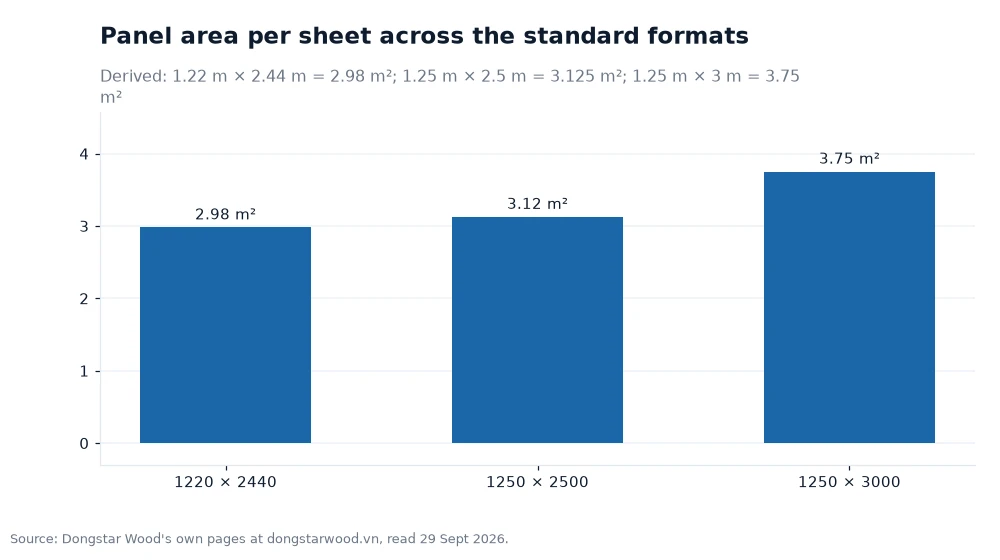
The three standard formats cover different areas, and the difference matters for estimating. The smallest sheet, 1220 × 2440 mm, gives 1.22 × 2.44 = 2.98 m²; the middle format, 1250 × 2500 mm, gives 1.25 × 2.5 = 3.125 m²; the largest, 1250 × 3000 mm, gives 1.25 × 3 = 3.75 m². The largest format yields 0.77 m² more than the smallest, which is a quarter more panel per sheet for the same handling effort.
Apply it to a fit-out. A hotel corridor needs 200 m² of panelling: at 2.98 m² per sheet that is 200 ÷ 2.98 = 67.1, so 68 sheets; at 3.75 m² per sheet it is 200 ÷ 3.75 = 53.3, so 54 sheets. Fourteen fewer sheets means fourteen fewer joints, fourteen fewer cuts and a faster installation — the format decision is a labour decision.
Frequently asked questions
What is the difference between E1 and E0?
Both are low-emission glue classes; E0 is the tighter grade for projects where the specification asks for less again. The difference is a number on a test report, and the test report is what the specification should reference.
When is CARB P2 documentation needed?
When the boards are destined for the United States. CARB P2 is the emissions documentation route named in the client's own compliance options, and it is the paper that lets a low-emission board enter a US building project.
Which sizes are quoted for birch boards?
Three standard formats are quoted: 1220 × 2440 mm and 1250 × 3000 mm at the extremes, with 1250 × 2500 mm between them. Custom sizes are available, and the thickness window reaches from 2.7 mm to 30 mm. The range runs from thin laminating substrates to thick structural panels.
From compliance to a finished interior
A low-emission board earns its place when the documentation and the finish arrive together. Birch Plywood Supplier pages list E1, E0, CARB P2 and CE as the compliance routes for the range, so the buyer can match the documentation to the market. See the okoume plywood page for the pale red interior panels that complement birch in a fit-out, and the commercial plywood category for the hardwood and veneer options that fill out a larger project. A buyer who specifies the glue class, the grade and the format together tends to find the interior goes up with fewer surprises.
The data behind this article was taken from the supplier's published pages as read on 29 Sept 2026[1].